Minimalist Home Design in Abuja: How Tropical Modernism Solves Real Problems
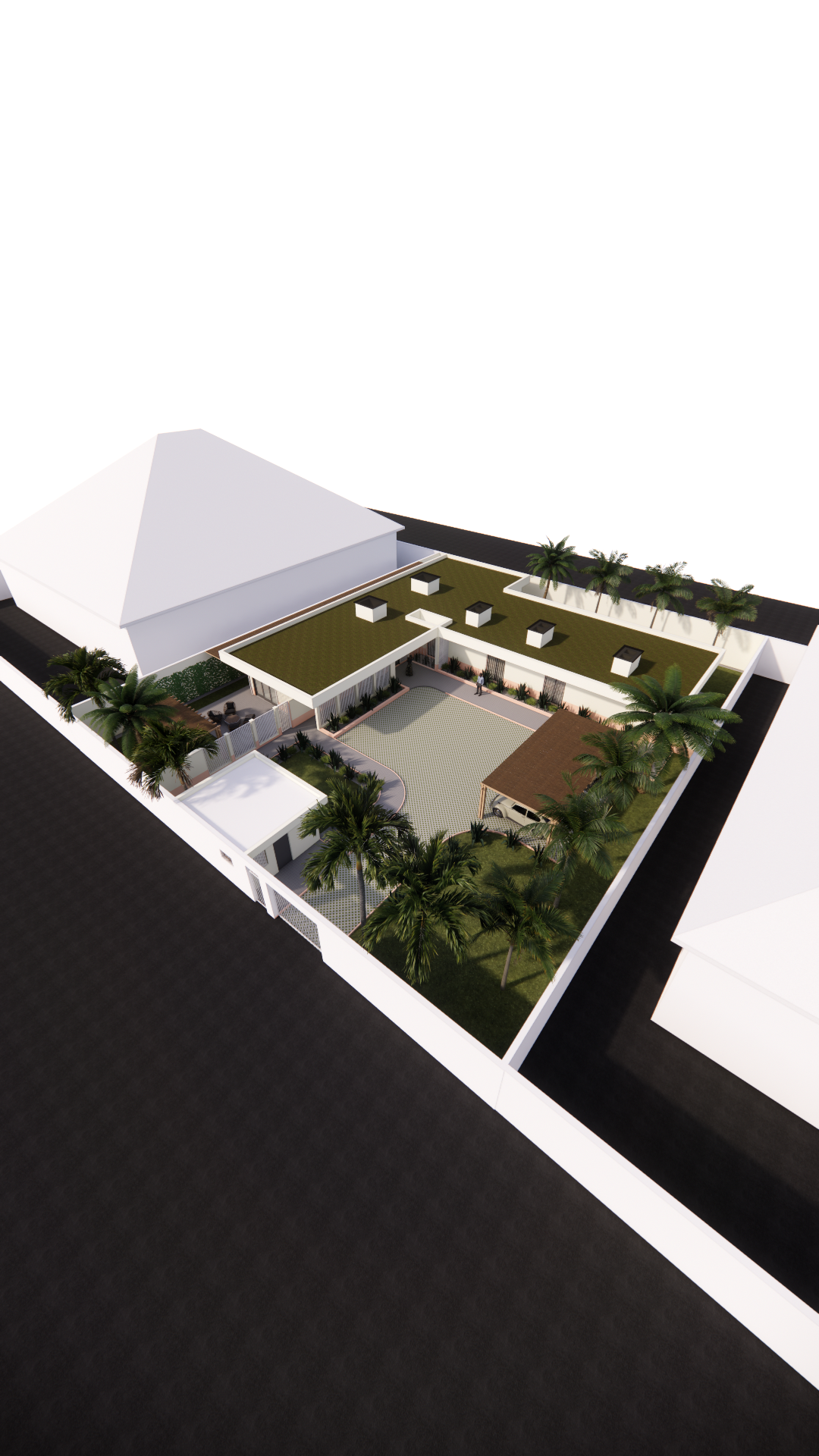
Birds eye view of villa concept design
Designing a minimalist home in Abuja is not simply a question of aesthetics. It is a question of climate, security, privacy, and how a family actually lives. This project, a three-bedroom residence in the Nigerian capital, gave me the opportunity to work through all of those questions at once, drawing on the principles of tropical modernism and passive house design to create a home that performs as beautifully as it looks.
The client wanted something colourful yet restrained, filled with natural daylight, and cooled by the breeze rather than entirely dependent on air conditioning. What followed was a design process shaped by four real challenges — and four considered responses.
Challenge 1: Security Without Sacrificing Light
Security Grille Open
Large areas of glazing are a common feature of contemporary minimalist home design, but in Abuja, large unprotected glass openings can attract unwanted attention. The challenge was to bring natural daylight deep into the plan without creating vulnerability.
Our solution was to design controlled window sizes generous enough to flood the rooms with light, but positioned and scaled to avoid presenting an obvious target. We then introduced sliding security grilles that move entirely out of sight during the day, allowing the home to feel open and connected to its gardens, but providing solid protection when locked in place at night. Security and openness don't have to be in opposition — they just need to be designed together from the start.
Challenge 2: Privacy in a Dense Neighbourhood
The site sits in a densely populated part of the city. The client's priority was simple: they didn't want neighbours looking directly into their home. The typical solution, high boundary walls or net curtains, would have closed the house off from light and air. We took a different approach.
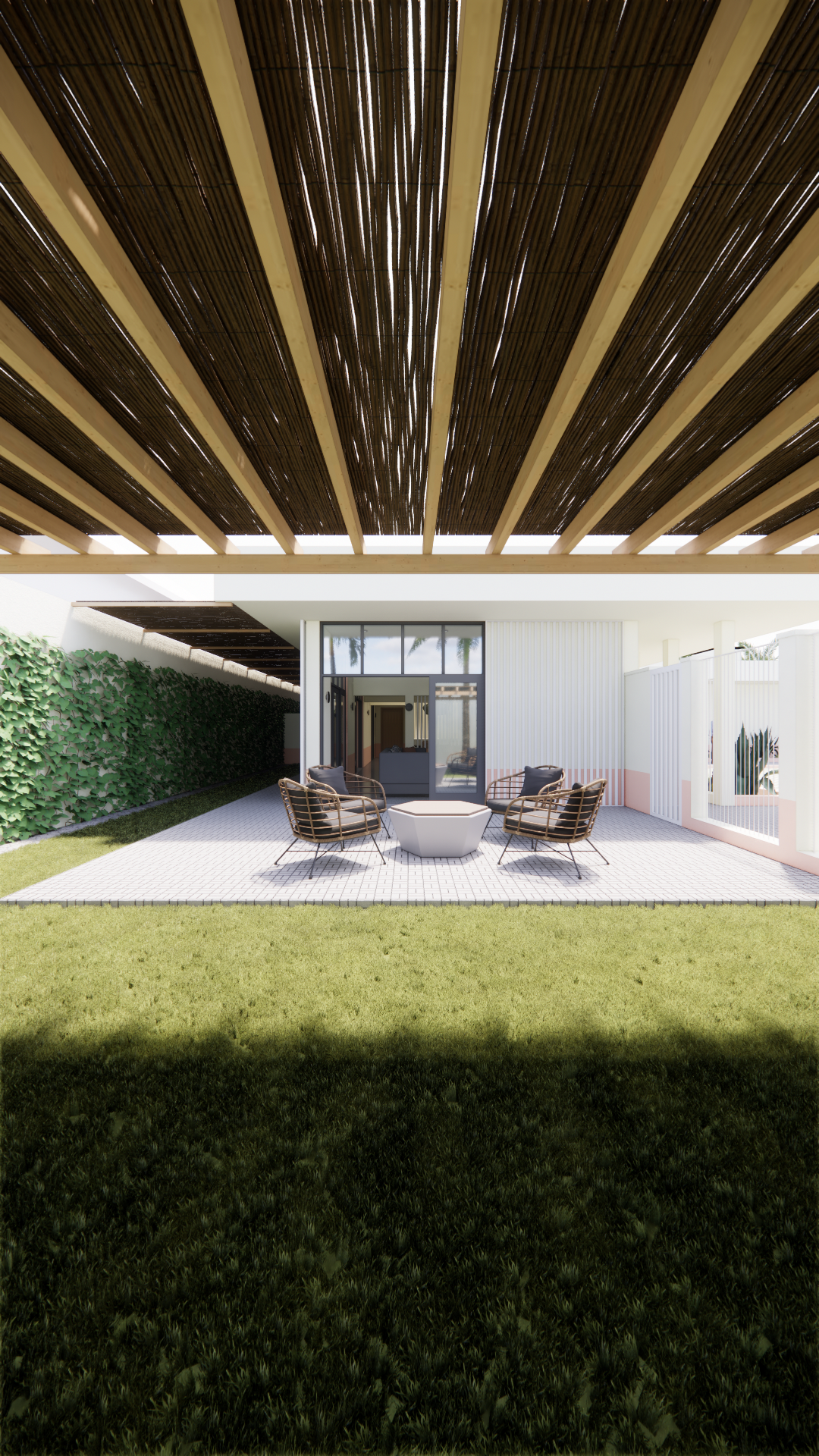
By designing the home as a single-storey volume, the building naturally sits below the eyeline of neighbouring properties. We extended generous roof overhangs from the structure, with woven mats fixed beneath timber beams — a detail drawn from traditional Nigerian building culture that creates a soft visual filter without blocking airflow or daylight.
Those overhangs do something else, too. They shade the walls beneath throughout the hottest parts of the day, reducing heat absorption at the point where the sun would otherwise be most damaging. It is almost like giving the building its own hat.
Challenge 3: Keeping Cool Without Air Conditioning
Natural ventilation was central to the brief and central to how we organised the entire plan. The layout of the home was designed around cross ventilation, with large openings aligned to allow prevailing winds to move freely from one side of the building to the other. Fresh air flows through the communal spaces constantly, reducing the heat that builds up in a sealed, air-conditioned environment.
To boost daylight and assist cooling further, we introduced a series of punched skylights in the roof. These bring natural light into the heart of the plan where windows alone cannot reach, and they allow hot air to rise and escape through the top of the building, a stack effect that works with the physics of heat rather than against it.
Air conditioning was deliberately limited to the bedrooms. In a communal space that is constantly being opened and used, mechanical cooling is inefficient and expensive to run. The passive design of the communal areas, the cross ventilation, the overhangs, and the skylights mean those spaces remain comfortable without it.
A green roof completes the thermal strategy. Planted with vegetation, it absorbs solar heat at the roof level rather than allowing it to radiate down into the rooms below. The result is a noticeably more stable interior temperature throughout the day, and a significantly reduced cooling load on the building overall.
Challenge 4: Building Smart with Local Materials
Cost-effective construction in Nigeria requires careful thought about the supply chain. We made a conscious decision to specify off-the-shelf materials wherever possible — not as a compromise on quality, but as a deliberate strategy to keep the build straightforward, procurement reliable, and costs predictable.
The one exception was the glazing units, which due to their height and span required bespoke manufacturing. Everything else — the structure, the roof, the internal finishes — was specified to be sourced and built locally, reducing delays and keeping skilled labour costs within the project budget.
Rooted in Tradition, Guided by Passive House Principles
The design of this home reaches in two directions at once. Passive house principles shaped how we thought about energy performance — minimising mechanical cooling, reducing heat gain through the building fabric, maximising natural ventilation. At the same time, traditional Nigerian tribal home layouts shaped how we thought about the organisation of space, the relationship between indoors and outdoors, and the role of the courtyard and threshold in family life.
Tropical modernist architecture in West Africa has always understood something that contemporary design sometimes forgets: that the most intelligent response to a hot climate is not a more powerful air conditioning unit. It is a building that works with its environment — that uses shade, breeze, mass, and orientation to stay comfortable without consuming energy to do so.
This project is a small step in that direction. I hope it is useful — whether you are planning a home in Abuja, Lagos, or anywhere the sun makes the same demands.